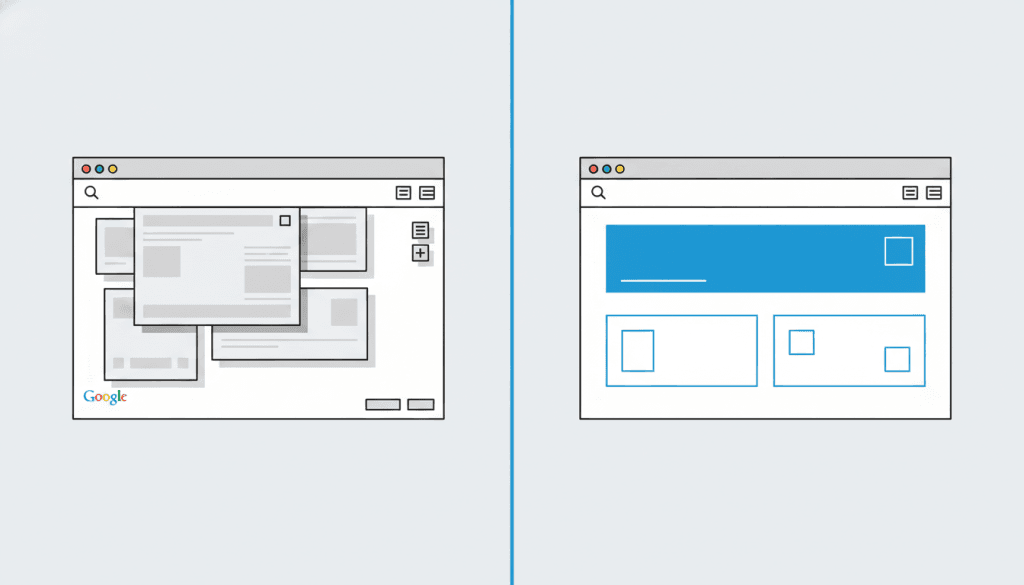
Most business owners know their website has problems before they admit it out loud. The site looks the same as it did five years ago, the phone doesn’t ring the way it used to, and every time someone asks for the URL there’s a small knot of embarrassment. Here are seven clear signs it’s time to stop patching and start rebuilding.
1. Your Site Looks Dated or Embarrassing
Design trends move fast. A site that looked modern in 2018 often feels tired today — heavy drop shadows, cluttered layouts, fonts that scream “generic template.” If you hesitate before handing someone your URL, that hesitation is data.
Your website is your first impression for every prospect who searches your name before calling. A dated site quietly signals that your business might be dated too — even when that’s completely false. A professional redesign changes that impression in a way that no amount of word-of-mouth can compensate for.
2. Your Site Isn’t Mobile-Friendly
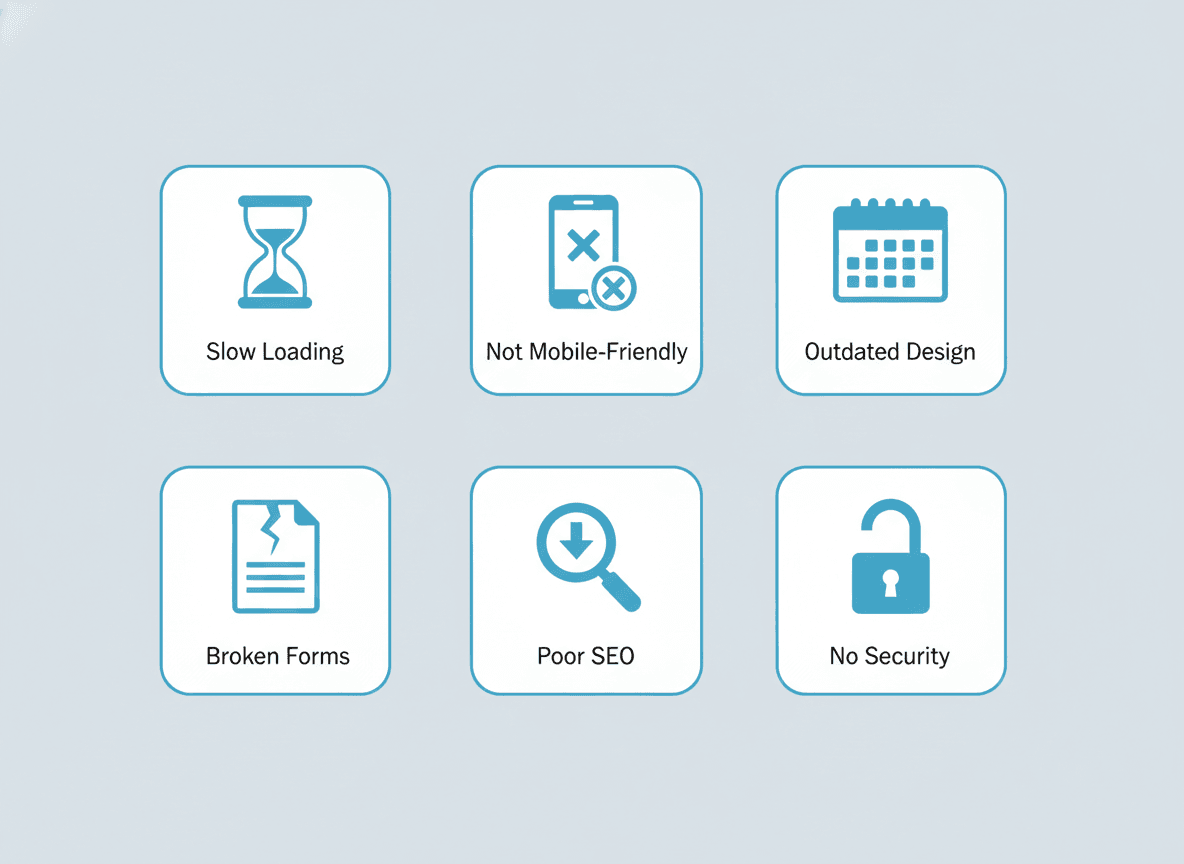
More than half of all web traffic happens on phones. If your site doesn’t resize cleanly, forces users to pinch and zoom, or hides your phone number under a menu that doesn’t work on touch — you’re losing leads every single day. Google also penalizes non-mobile sites in search rankings. There’s no excuse for a site that doesn’t work on a phone in 2026. Read more about why this matters in our post on why a mobile-friendly website matters more than ever.
3. It Loads Slowly
Every second of load time costs you visitors. Research consistently shows that load times above three seconds cause most mobile users to bounce before the page appears. Slow sites also rank lower on Google — page speed is a confirmed ranking factor. If your site takes more than two to three seconds to load on a phone, you’re paying a tax on every marketing dollar you spend driving traffic to it.
Speed problems can sometimes be fixed without a full rebuild, but on older platforms — especially Wix sites, outdated WordPress installs, or sites built on old page builders — the underlying architecture is often the culprit and a rebuild is faster than trying to fix it.
4. You Can’t Update It Yourself
If changing your hours, adding a new service, or updating a team member photo requires emailing your developer and waiting a week, your site is running you instead of the other way around. A well-built WordPress site lets any non-technical owner make content changes in minutes. If you can’t do that, the site’s CMS is the problem — not your technical ability.
5. It Isn’t Generating Leads
This is the bluntest test. Your website’s job is to turn visitors into leads. If it isn’t doing that — if you track analytics and see visitors arriving and leaving without contacting you — the site is failing its core purpose. Often the culprit is a combination of unclear messaging, weak calls to action, and no real conversion architecture. This is exactly what a conversion-focused redesign addresses.
In our experience working with Phoenix-metro businesses, a well-designed site built with clear conversion intent can dramatically change inquiry volume, sometimes within weeks of launch. If your site isn’t producing, it needs to change.
6. Your Competitors’ Sites Are Better
Search for what your customers search. Look at the top three results for your service in Scottsdale or the Phoenix metro. How does your site compare? If competitors have cleaner design, better structure, and stronger copy, some of your potential customers are choosing them in part because of that. A site that looks inferior signals an inferior business — fairly or not.
Pair a redesign with a solid brand refresh and the gap between you and competitors can flip quickly.
7. It Doesn’t Match Your Business Anymore
Businesses evolve. Services get added. Niches get sharper. Teams grow. If your website still describes the business you were three years ago — or worse, lists services you no longer offer — it’s actively misleading prospects. A site that reflects where your business actually is today builds more trust than a “good enough for now” band-aid update.
A site rebuild also gives you the chance to reconsider your local positioning, update your service messaging, and build the kind of targeted landing pages that speak directly to the customers you want most. Our post on how a redesign grows your business walks through the real downstream impact of getting this right.
If more than three of these signs sound familiar, it’s time to have a conversation. Reach out for a free assessment and we’ll be straight with you about what your site needs.
Frequently asked questions
How often should a business website be redesigned?
There’s no fixed schedule, but most business websites benefit from a meaningful refresh every three to five years — or sooner if the site was never built well to begin with. Design trends shift, platforms evolve, and your business changes. The better question is: is the site performing? If it’s not generating leads or you’re embarrassed by it, those are stronger signals than any calendar date.
Can I redesign just parts of my site, or does it have to be all-or-nothing?
Selective redesigns are possible — updating the homepage, adding new service pages, or freshening the visual design without rebuilding everything. The challenge is that piecemeal fixes often create inconsistency and don’t address structural problems like slow load times or a weak mobile experience. For most businesses, a full rebuild is cleaner and more cost-effective than repeated patching.
Will a redesign hurt my SEO?
A poorly executed redesign can temporarily affect rankings if URLs change without proper redirects, content is removed, or on-page SEO is accidentally broken. A well-managed redesign — with URL mapping, redirects, and careful content migration — should preserve or improve your SEO. If your current site has poor SEO to begin with, a properly built new site will almost certainly perform better over time.
How long does a website redesign take?
A typical small-to-mid business redesign takes six to twelve weeks from kickoff to launch, depending on the site size, how quickly client feedback comes in, and whether content needs to be written from scratch. Rush timelines are possible but usually cost more and produce less refined results.
What should I do with my current site during a redesign?
Keep it live. Your current site is still your business’s online presence until the new one launches, and taking it down while rebuilding creates an unnecessary gap. Most studios build the new site in a staging environment and swap to the live domain at launch — the transition takes minutes, not days.