Trends in web design are worth paying attention to — but selectively. Some signal genuine shifts in how users interact with the web. Others are stylistic fads that will feel dated in two years. Here’s an honest look at what’s actually worth adopting for a Scottsdale business website in 2026.
Clarity Over Cleverness
The most significant shift in high-performing business sites right now isn’t a visual trend — it’s a strategic one. The best sites are getting simpler, not more complex. As AI-generated design floods the web with gradient blobs, busy hero animations, and pseudo-premium dark-mode everything, the sites that stand out are crisp, direct, and easy to scan.
For a local service business in Scottsdale, this is genuinely good news. You don’t need to chase visual complexity. You need to be immediately clear about what you do and why a visitor should trust you. Clean layout, excellent typography, fast load times, and a confident single CTA outperform every flashy design trend we’ve seen.
This philosophy is built into how we approach custom web design — beauty exists to serve conversion, not the other way around.
AI-Assisted Content and Personalization
AI tools are changing what’s possible in content creation, and the businesses that use them smartly are publishing more consistently without sacrificing quality. In 2026, a well-maintained blog with genuinely useful articles is still a strong differentiator in local search — because most businesses either don’t publish at all or publish generic filler that Google is increasingly good at ignoring.
Where AI is less helpful is in strategy and positioning. The businesses winning in local search aren’t doing it by publishing more AI copy — they’re doing it with content that has real local context, genuine expertise, and specific answers to the questions their customers are actually asking. For a Scottsdale home services company or a dental practice, that means content about your specific market, your specific patients, and your real experience — not generic dental marketing copy.
Performance as a Design Standard
Page speed has been a ranking factor for years, but in 2026 it’s increasingly a design expectation, not just a technical one. Visitors on mobile connections have very little patience for slow sites, and Google’s Core Web Vitals scores are a direct proxy for user experience.
The trend we’re seeing: studios that build on lean, well-optimized foundations — whether that’s clean WordPress builds or lightweight custom stacks — are seeing meaningfully better search performance than those that pile on page builders and heavy themes. If your site has a Lighthouse performance score below 70, that’s costing you both rankings and conversions.
Scroll Storytelling and Visual Hierarchy
One trend worth adopting: intentional scroll architecture. The best sites in 2026 don’t dump all their information on a page and hope visitors find what they need. They guide visitors through a deliberate narrative — from hook to problem acknowledgment to solution to proof to action.
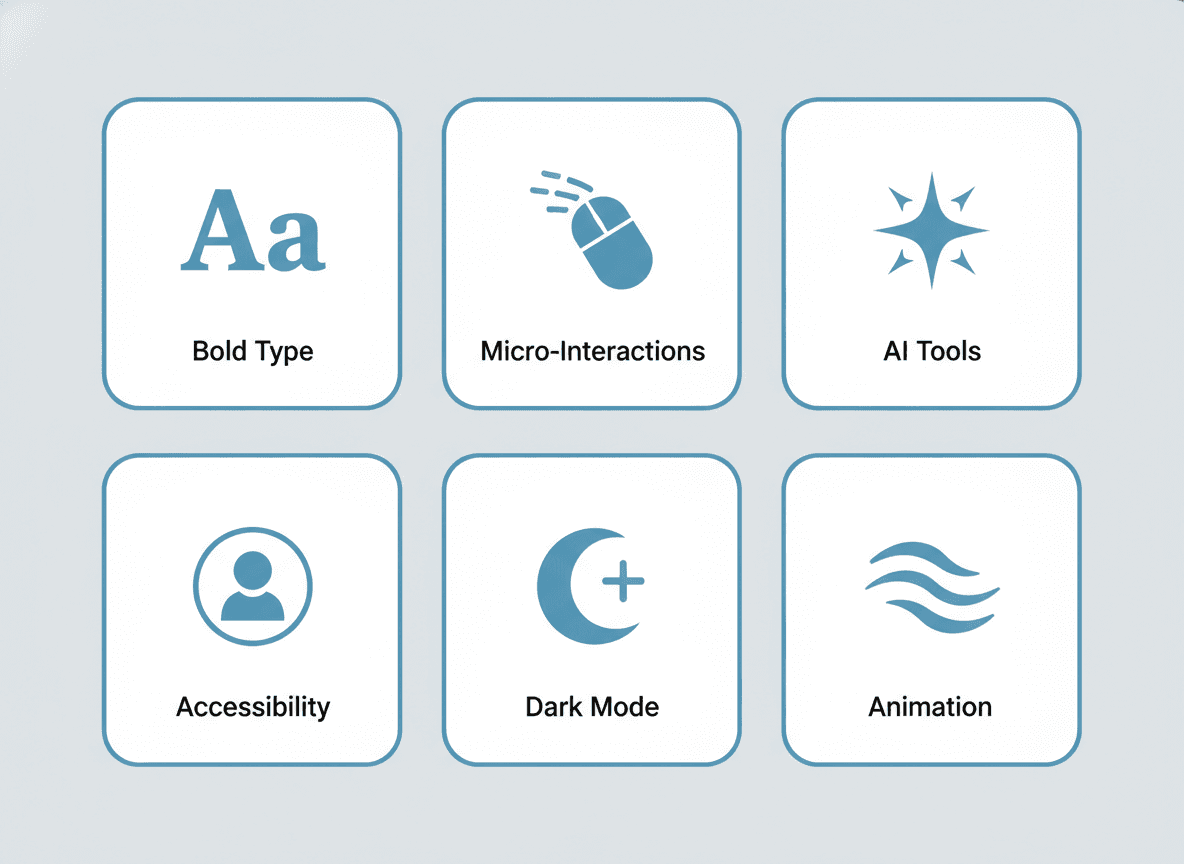
This is distinct from gimmicky scroll animations. It’s about sequencing content so that each section earns the visitor’s continued attention. A homepage that tells a coherent story in the scroll outperforms a homepage that lists features and hopes for the best. This approach directly ties into what makes a website convert — structure and sequence matter as much as design.
When combined with strong visual hierarchy — clear H2s, scannable bullet points, pull quotes, strategic use of space — this kind of page becomes genuinely easy to navigate for a busy business owner in their car between appointments.
What to Ignore in 2026
Some trends are better left to trend-chasers:
- Aggressive dark mode defaults — Dark sites look dramatic in design portfolios, but for most local service businesses, a clean light design reads as more professional and trustworthy to the 35–60-year-old decision-maker who’s your actual customer.
- Animated hero videos — They kill load times, add no conversion value, and most visitors don’t watch them.
- Chatbot pop-ups on arrival — Almost universally annoying as a first experience. Deploy them with delay and intent, not immediately.
- Over-engineered micro-animations — Subtle motion that aids navigation is fine. Motion for motion’s sake slows the experience and signals “agency showreel,” not “serious business.”
If you’re looking at a redesign or a new build this year, the most valuable investment you can make isn’t chasing the latest design trend — it’s building a site that’s fast, clear, and built around how your specific customers make decisions. Our team works in Scottsdale and the Phoenix metro every day, and we know what works here.
Get in touch for a free consultation and we’ll give you our honest take on where your site stands.
Frequently asked questions
Should a local business website follow design trends?
Selectively. Your site should feel current — not using 2015 visual patterns — but chasing every design trend is a mistake for most local businesses. Focus on the trends that improve usability and conversion: clarity, speed, mobile-first design, and clean hierarchy. Ignore trends that are visually interesting but make the experience harder or slower.
Is dark mode worth implementing for a business website?
For most local service businesses, no. Dark designs look sharp in design portfolios but tend to feel intimidating or harder to read for the non-technical business owners and professionals who are your actual customers. A clean, light design with strong contrast reads as more professional and trustworthy for SMB audiences. Dark mode is better suited to SaaS products, tech brands, and agencies targeting other designers.
How important is page speed in 2026?
Very. Google uses Core Web Vitals as a ranking signal, and visitor behavior data consistently shows that every second of load time above two seconds reduces the percentage of users who stay. For mobile visitors — which is most of your traffic — a slow site is an invisible leak in your marketing funnel. Speed is not optional for a high-performing site.
What typography and font trends are performing well right now?
Editorial serif headlines paired with clean, readable sans-serif body text are seeing a strong revival — driven partly by a reaction against generic sans-serif-everything that feels interchangeable. Large, confident type that communicates directly (not clever taglines) is outperforming elaborate decorative typography. Readability and hierarchy matter more than novelty.
How often should a business update its website design?
Full visual redesigns every three to five years is a reasonable rhythm for most businesses. More important than the calendar is whether the site still reflects your brand accurately, loads fast, and converts visitors. If it fails those tests, don’t wait. If it’s performing well, there’s no need to redesign just to follow trends.