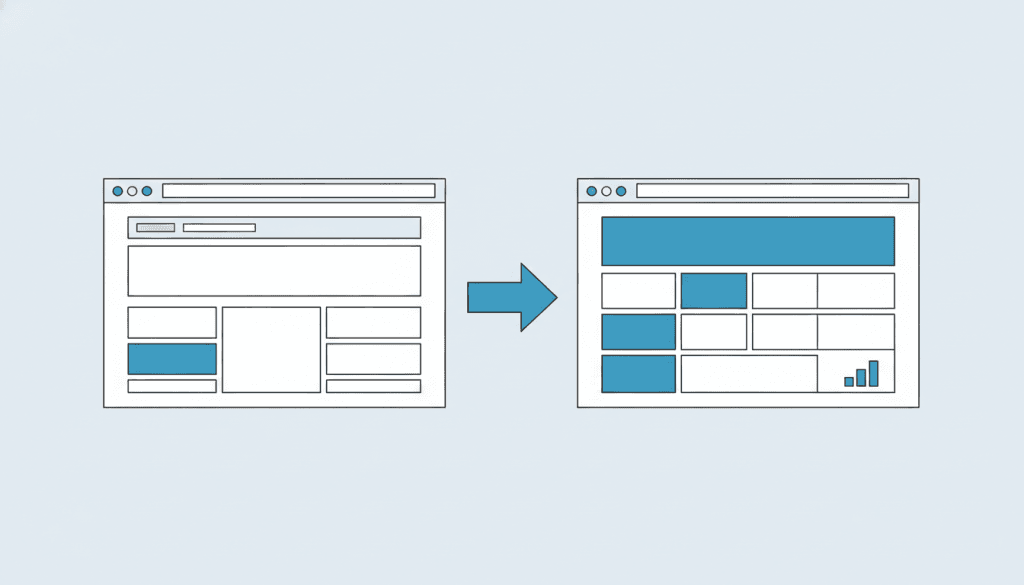
A website redesign often gets treated as a cosmetic project—a refresh to make things look more current. The businesses that get the most out of a redesign approach it differently: as a strategic investment in how they generate leads, build credibility, and serve existing customers.
The hidden cost of an outdated site
An outdated website costs you in ways that don’t show up on any invoice. Every visitor who arrives and immediately leaves because the site looks untrustworthy is a lead that went somewhere else. Every phone call that didn’t happen because the mobile experience was too frustrating is a sale you didn’t get to make. These losses are invisible because you never see the missed opportunity—just the absence of the result.
Search visibility is another quiet casualty. Google’s Core Web Vitals now factor site performance into rankings. A site built in 2018 or earlier almost certainly has technical problems—slow load times, non-mobile-friendly layout, missing schema markup—that cost you positions in local search results. In a competitive market like Scottsdale, where many service categories have well-resourced competitors, that visibility loss translates directly to revenue.
Many of the businesses we work with first identify the problem through a moment of contrast: a competitor launches a new site and suddenly seems more credible, or a team member shares the analytics and the bounce rate has quietly been above 75% for a year. If you’re seeing signs that your site needs a redesign, the cost of waiting is usually higher than the cost of acting.
What a strategic redesign actually changes
A well-executed website redesign changes three things that directly affect business growth: conversion rate, search visibility, and brand perception.
Conversion rate is the percentage of visitors who take the action you want—calling, filling out a form, making a purchase. Most small business websites don’t have a conversion problem because of bad traffic. They have one because the site doesn’t clearly communicate what the business offers, who it’s for, and what to do next. A redesign built around conversion thinking restructures the entire experience around those questions.
Search visibility improves when technical issues are resolved, page speed is addressed, content is restructured for search intent, and local schema is implemented correctly. These aren’t magic—they’re table stakes for competitive local search. A modern rebuild establishes that foundation.
Brand perception shifts immediately with a design that looks credible and professional. First impressions happen in under three seconds. A site that looks like it was built five years ago communicates something about the business, whether you intend it to or not.
Real areas where growth shows up
In our experience with Phoenix-metro businesses, a successful redesign tends to show growth in a few predictable places. Form submissions and phone calls increase when the site makes it clearer what to do. Return visit rates improve when the site gives people a reason to come back—through useful content, clear service information, and a site that loads quickly enough to be worth revisiting.
For service businesses, the quality of inbound leads often improves more than the volume. A site that clearly explains who you work with and what results you produce attracts better-fit prospects. For home services businesses, that means fewer mismatched service area calls. For real estate professionals, it means more serious buyers and sellers reaching out rather than browsers.
eCommerce sites see the redesign impact most directly in cart abandonment rates and average order value—both of which improve when the shopping experience is smoother and the brand feels more trustworthy. A professional eCommerce design built around the customer journey rather than feature assembly consistently outperforms the original.
How to approach the redesign conversation
The most productive redesign projects start with analytics and an honest audit of the current site’s performance, not with a mood board. What are visitors doing on the current site? Where are they leaving? What pages get traffic and which are invisible? That data shapes the strategy for the new site in ways that gut instinct alone cannot.
From there, the redesign conversation covers positioning (what the site needs to say), structure (how visitors move through it), and then design (how it looks and feels). Working in that order is what separates a redesign that grows a business from one that just looks better.
If you’re wondering whether a redesign is the right next step, it helps to look at it alongside how to choose the right web design partner for the project. The process matters as much as the end product.
Reach out for a free quote and we’ll start with a candid look at your current site and what a redesign could realistically do for your business.
Frequently asked questions
How long does a website redesign take?
A professional small-to-mid business website redesign typically takes 6–12 weeks from strategy kickoff to launch. Simpler sites on a tight scope can move faster. Sites with complex functionality, large content libraries, or multiple stakeholders take longer. The biggest variable is usually feedback turnaround on the client side—projects that get timely decisions finish on schedule.
Will a redesign hurt my current search rankings?
Done correctly, no. A redesign with proper URL redirect mapping, preservation of existing on-page SEO elements, and improved technical performance will typically improve rankings over time. Done carelessly—changing URLs without redirects, removing content that had search equity, not maintaining metadata—a redesign can cause temporary or lasting ranking drops. This is why SEO should be part of the redesign strategy from day one, not an afterthought.
How do I measure whether the redesign was successful?
Establish baseline metrics before the redesign launches: bounce rate, average session duration, pages per session, form conversion rate, and organic search traffic. Set targets and a timeline—typically 90 days post-launch to begin drawing conclusions. A successful redesign should show improvement in at least conversion rate and bounce rate relatively quickly, and in organic traffic over 3–6 months.
Should I redesign my site or just update it?
Update if the structural problems are minor: outdated photos, a few pages with weak copy, a color scheme that feels slightly dated. Redesign if the fundamental experience is broken: a non-mobile-friendly layout, slow page speeds under 60 on PageSpeed, an architecture that buries key information, or a design that’s significantly behind competitors. When in doubt, an honest audit from an outside perspective usually clarifies the answer.
Do I need to replace all my content during a redesign?
Not necessarily. Content that’s well-written, accurate, and still reflects the business can carry over. Most redesign projects involve auditing existing content: some pages are updated, some are rewritten, some are consolidated, and some are removed entirely. The goal is a leaner, more purposeful site—not a content migration for its own sake.