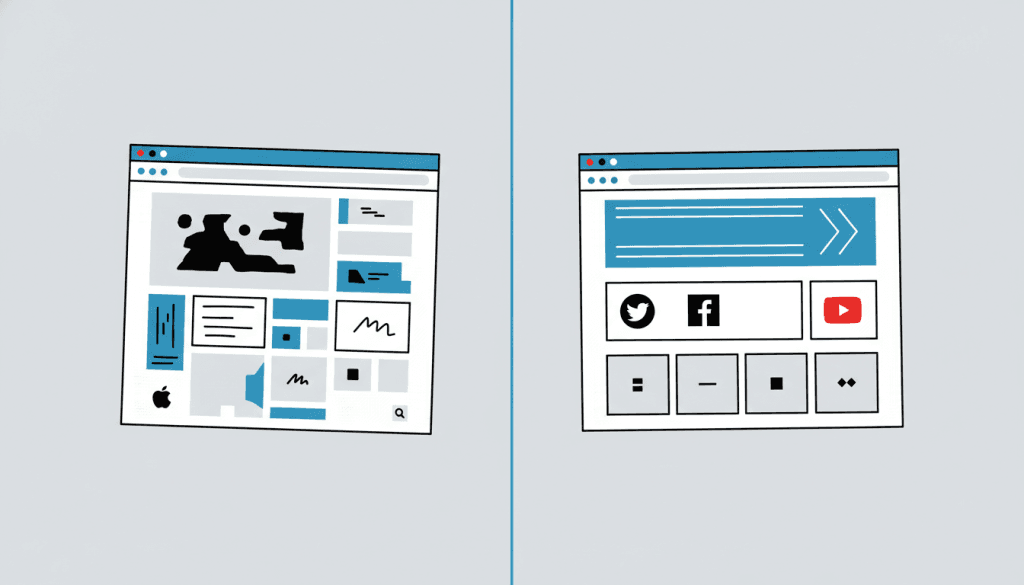
Wix, Squarespace, and similar platforms have made it genuinely possible for a business owner to put up a website without hiring anyone. The question isn’t whether you can—you can—but whether you should, and what the real-world difference in outcome looks like.
What DIY website platforms actually offer
The major DIY platforms have improved significantly over the last five years. Squarespace in particular produces clean, good-looking sites with minimal effort. Wix is flexible and has a wide app ecosystem. Shopify is excellent for straightforward product selling. For someone with a good eye and some time to learn the tool, a DIY platform can produce something presentable.
What these platforms are genuinely good for: testing a business concept before committing to a full investment, creating a basic online presence for a very early-stage venture, or building landing pages quickly for experiments. They lower the cost and time barrier to having something live.
What they consistently don’t produce: differentiated design, serious local SEO foundations, conversion-optimized experiences, or sites that look distinctively like your specific business rather than like every other business on the same platform. The constraints that make DIY fast are the same constraints that put a ceiling on the result.
The hidden costs of DIY
DIY isn’t free. Monthly platform fees range from $16 to $65+ for business plans. That compounds to real money over time. More significant is the time cost: building a professional-looking DIY site from scratch, without design experience, typically takes 40–80 hours for someone learning the tool as they go. For a business owner billing even $50/hour, that’s $2,000–$4,000 in time value—comparable to the cost of entry-level professional work, except you end up with less.
There’s also an opportunity cost component. The hours spent fiddling with fonts and trying to make a drag-and-drop builder do something it wasn’t quite designed for are hours not spent on revenue-generating activities. This is the calculation that often goes unmade in the DIY vs. hire decision.
And then there are the costs that appear later: a DIY site that was never built for local search remaining invisible despite months of effort, a platform migration when the business outgrows the tool’s limitations, or a complete rebuild when the site looks too amateurish to show prospects. The real cost of a low-investment website almost always exceeds the apparent savings.
Where professional web design creates measurable value
A professional web design engagement produces three things a DIY platform typically cannot.
Distinctive visual identity. A designer can create something that looks unmistakably like your business—the visual equivalent of a tailored suit versus off-the-rack. In a competitive local market like Scottsdale or the broader Phoenix metro, standing out in the first three seconds matters. A site that looks like every other Squarespace site is competing on luck, not design.
Conversion architecture. Professional designers understand how visitors move through a site and what makes them take action. The order of information, the calls to action, the messaging hierarchy, the way trust signals are deployed—these are studied disciplines that produce measurably different outcomes. Most DIY sites are built around what the owner wants to say, not around how a visitor decides to take action.
Technical foundations. Page speed, schema markup, heading structure, mobile performance, Core Web Vitals—these are the invisible factors that determine how well your site ranks in local search. A professionally built WordPress site is built with these foundations in place. A DIY site almost never is, and retrofitting them later is harder than building them in from the start.
Who should seriously consider DIY
DIY makes sense in specific circumstances: if you’re genuinely pre-revenue and not yet sure the business model works, a basic DIY site is a reasonable placeholder. If your business is entirely referral-driven and your website is primarily a credibility check rather than a lead source, a clean DIY site may be sufficient. If you have a strong design background and the time to execute well, DIY platforms can produce genuinely good results.
For established businesses where the website is a primary lead-generation tool—which describes most home services businesses, dental and medical practices, and professional service firms in competitive Phoenix-metro markets—DIY consistently underperforms professional work in conversion and search visibility. The ROI math usually favors professional investment within the first year.
The honest comparison on cost
Professional web design for a small business typically starts around $3,000–$5,000 for a well-built 5–10 page site. DIY platforms cost $20–$65/month plus your time. Over three years, a DIY platform with modest time costs is often comparable in total investment to a professional build—except the professional build typically generates more leads, ranks better, and doesn’t need rebuilding when you decide the DIY version isn’t performing.
If you’re currently on a DIY platform and wondering whether it’s time to make the investment in something built properly, a website redesign conversation is a good starting point. We can look at your current site, what it’s actually doing for your business, and what a professional build would realistically change. Reach out for a free quote—the conversation is always worth having before making the call.
Frequently asked questions
Is Squarespace or Wix good enough for a real business?
For very small or early-stage businesses, yes, as a starting point. For businesses competing actively in local search, trying to convert meaningful traffic into leads, or operating in categories where credibility is a purchase prerequisite, the ceiling of these platforms becomes apparent. They produce websites that work; they rarely produce websites that differentiate, rank seriously in competitive local search, or convert at professional levels.
Can I start with DIY and upgrade to a professional site later?
Yes, and many businesses do exactly this. A DIY site as a placeholder while you validate your model is a reasonable use of the tool. When you upgrade, budget for a full rebuild rather than a migration—the architecture of a DIY site and a professionally built custom site are usually different enough that carrying over content (rather than the site structure) is cleaner. Your content, photography, and copy can transfer; the underlying build typically shouldn’t.
How do I know if my DIY site is actually underperforming?
Check your Google PageSpeed Insights score, your Google Search Console for organic impressions and click-through rates, and your analytics for bounce rate and session duration. If your mobile PageSpeed score is below 70, your organic impressions are flat or declining, and your bounce rate is above 70%, the site is underperforming regardless of how it looks to you. These are the metrics that tell the real story.
What if I can only afford a small budget for a professional site?
Honest answer: a small budget for professional web design produces a limited scope. A focused 4–5 page site built well is meaningfully better than a 15-page DIY build done poorly—fewer, stronger pages outperform more, weaker ones. If budget is genuinely constrained, prioritize homepage, one to two core service pages, and a contact page built to a professional standard. That’s a foundation you can build on.
What questions should I ask a web designer before hiring?
Ask to see their portfolio and specifically ask about results, not just visuals. Ask how they handle the discovery and strategy phase before design begins. Ask what’s included in maintenance after launch. Ask for references from similar businesses. And pay attention to how clearly they explain their process—a designer who can’t explain their thinking in plain language is often one who’s working more on instinct than strategy. Our guide to choosing a web design company covers this in more detail.