A $500 website sounds like a deal until you realize what it actually costs you. The price tag is just the beginning—what a cheap website costs in lost leads, damaged credibility, and eventual rebuilds typically dwarfs the original savings.
The price you see vs. the price you pay
The sticker price on a low-cost website usually covers one thing: someone putting a template live with your logo and basic information. What it rarely covers is strategy, custom design, performance optimization, conversion thinking, or any real understanding of your business.
The costs that follow are less visible but more significant. Cheap hosting goes down at the worst moments. Bloated page builders produce sites that load slowly, and slow sites lose visitors. Google penalizes poor page experience. A site that looks dated or amateurish in the first three seconds signals to a visitor that the business behind it might be too.
In our work with Phoenix-metro businesses, we’ve seen the same pattern repeatedly: a business gets a low-cost site, it underperforms, they try to fix it, and two years later they’re rebuilding from scratch. The total spend ends up higher than a professional build would have cost the first time.
What credibility costs
Your website is often the first impression a prospect has of your business. In a competitive market like Scottsdale, where many service categories have well-resourced competitors, a cheap-looking site actively works against you. Visitors make trust judgments in seconds, and design quality is one of the clearest signals they use.
A potential client comparing two law firms, two HVAC companies, or two dental practices will default toward the one whose site looks more professional, all else being equal. You worked hard to build your reputation. A $500 website can quietly undermine it every day it’s live.
This matters particularly for medical practices and law firms, where trust is a precondition for a prospect even considering a call. A site that looks assembled from a generic template communicates something about how the business operates—even when that message is completely wrong.
The SEO and traffic problem
Cheap websites are rarely built with search visibility in mind. They typically lack proper heading structure, metadata, schema markup, and the page speed that Google factors into rankings. A site that’s invisible to search is a site that requires you to pay for every visitor forever—through ads, through social, through manual outreach.
A professionally built site earns organic traffic over time. That traffic compounds: the content you create this year can bring visitors next year and the year after at no additional cost. Understanding local SEO fundamentals for Scottsdale businesses is part of why this matters—a site built without those foundations has a steep hill to climb.
The difference between a site that ranks and a site that doesn’t isn’t always visible to the eye. It lives in the technical construction, the content structure, and the on-page signals that a cheap build rarely includes.
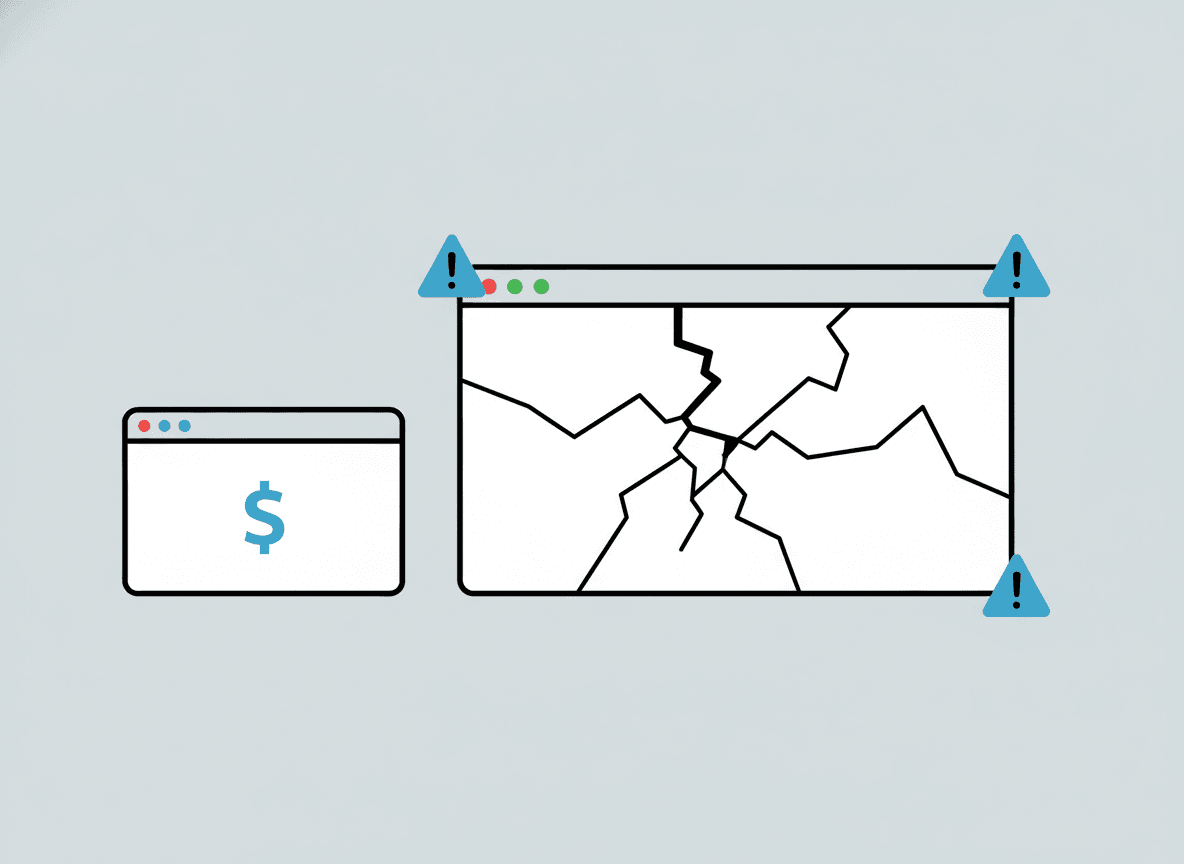
Maintenance and security costs
Cheap builds often use outdated themes, abandoned plugins, or configurations that create security vulnerabilities. WordPress sites built without proper maintenance planning get hacked. Hacked sites get blacklisted by Google. Getting un-blacklisted takes time and money and often destroys whatever search equity the site had built.
Understanding what ongoing website maintenance really involves is important before committing to any build. A good maintenance plan costs money, but it’s far less than recovering from a security incident or a failed site.
There’s also the time cost. Every hour you spend managing a malfunctioning cheap site, chasing a developer who’s stopped responding, or manually fixing things that should have been set up correctly is an hour not spent running your business.
What professional web design actually buys you
Professional custom web design buys you a site built to a strategy, not just to a template. It buys you performance built in from the start, not patched in afterward. It buys you conversion thinking—the site is designed to turn visitors into leads, not just to exist online. And it buys you a team that finishes the project, communicates clearly, and doesn’t ghost after the invoice is paid.
If you’re considering a website redesign after a disappointing first experience, you’re not alone. We’ve rebuilt sites for many Valley businesses whose original build left them with something they were embarrassed to share. The rebuild conversation almost always starts with “we wish we’d done it right the first time.”
Done right, a professional website isn’t an expense—it’s the sales tool that works for you around the clock. Reach out for a free quote and we’ll give you an honest picture of what’s actually possible for your budget.
Frequently asked questions
What should a professional small business website actually cost?
For a professionally designed, conversion-focused small business website in the Phoenix metro, expect to invest somewhere between $3,000 and $8,000 depending on complexity, the number of pages, and any custom functionality needed. Ongoing maintenance typically runs $50–$150 per month. These ranges reflect real professional work—not templates—and the investment pays for itself when the site actively generates leads.
Why do some web designers charge so little?
Low-cost providers typically use stock templates, offshore the work, cut corners on performance and strategy, or are very early in their careers. None of those things are automatically fatal, but they consistently produce sites that underperform. The lowest price usually reflects the lowest investment in understanding your business, your customers, and what the site needs to actually do.
Can I upgrade a cheap website instead of rebuilding?
Sometimes, but often not cost-effectively. If the underlying build has structural problems—poor code, a bloated page builder, weak hosting configuration—layering improvements on top is like renovating a house with a bad foundation. We assess existing sites regularly, and when we recommend a full rebuild it’s because patching it would cost more over time than starting fresh.
How do I evaluate whether a web designer is worth their price?
Look at their portfolio critically—do the sites load fast, look genuinely custom, and feel credible? Ask about their process: do they do discovery, write a strategy, explain the conversion approach? Check how they handle communication and revision. A designer who can explain the “why” behind their decisions, not just the “what,” is usually worth their fee.
Is a DIY website ever good enough?
For a very early-stage business testing an idea, a clean DIY site on a reputable platform like Squarespace can be a reasonable starting point. But for an established business competing in a real market, the ceiling of a DIY site is usually visible—in design quality, performance, and the absence of conversion strategy. Most businesses outgrow DIY faster than they expect.