Every business owner building a website faces the same fork in the road: WordPress or a fully custom-coded site? The answer shapes your budget, your timeline, and how much control you’ll have five years from now.
What “custom-coded” actually means
A custom-coded website is built from scratch—HTML, CSS, JavaScript, and a back-end language like PHP or Node.js—without relying on any content management system. The developer writes every function line by line. Nothing exists until they type it.
This approach produces extremely lean, fast sites. There are no plugin conflicts, no CMS bloat, and no licensing fees. Performance ceilings are high. But there are real trade-offs: the cost is substantial, the timeline is longer, and once the developer is gone, so is the ability to make edits without hiring them back. A small dental practice that wants to add a new doctor bio every six months will find a custom-coded site quietly frustrating.
Custom-coded sites make the most sense for web applications—think SaaS dashboards, booking engines with complex logic, or platforms that serve hundreds of thousands of users. For a service business or professional firm, it’s often overkill.
What a well-built WordPress site can do
WordPress powers roughly 40% of all websites on the internet. The reason isn’t that it’s the cheapest option—it’s that it sits in an unusually useful middle ground: flexible enough for serious customization, accessible enough for an owner to update the team page without calling anyone.
A professional WordPress build is not the same as a $500 Fiverr template. Done right, it includes a thoughtfully engineered custom theme, a clean block-editor setup so content updates are easy, and performance tuning that keeps page speeds honest. The result is a site that looks and behaves like custom work—because the theme layer is custom work—while the CMS underneath is stable, widely supported, and yours to manage.
We’ve built WordPress sites for law firms, HVAC companies, and medical practices throughout the Phoenix metro, and in nearly every case the owners are editing content themselves within a week of launch. That matters for home services businesses that add seasonal promotions, and for law firms that publish practice area updates regularly.
The honest performance comparison
Speed is the most common argument for custom code, and it’s partially valid. A bare HTML file will always load faster than a WordPress page. But modern WordPress, properly optimized—a lean theme, minimal plugins, a CDN, server-side caching, and compressed assets—routinely hits Core Web Vitals scores in the 90s on Google PageSpeed Insights. The gap between optimized WordPress and a well-built custom site is often imperceptible to real users.
Where WordPress genuinely struggles is when it’s loaded with bloated page builders, a dozen redundant plugins, and a theme that was never designed for performance. That’s a build quality problem, not a platform problem. The platform question is only part of the equation; custom design versus template design is a separate, equally important decision.
Cost and long-term ownership
A custom-coded site typically costs more upfront because you’re paying for every function to be built rather than configured. Ongoing, you’re also more dependent on the original developer for changes. That’s a meaningful hidden cost that rarely shows up in the initial quote.
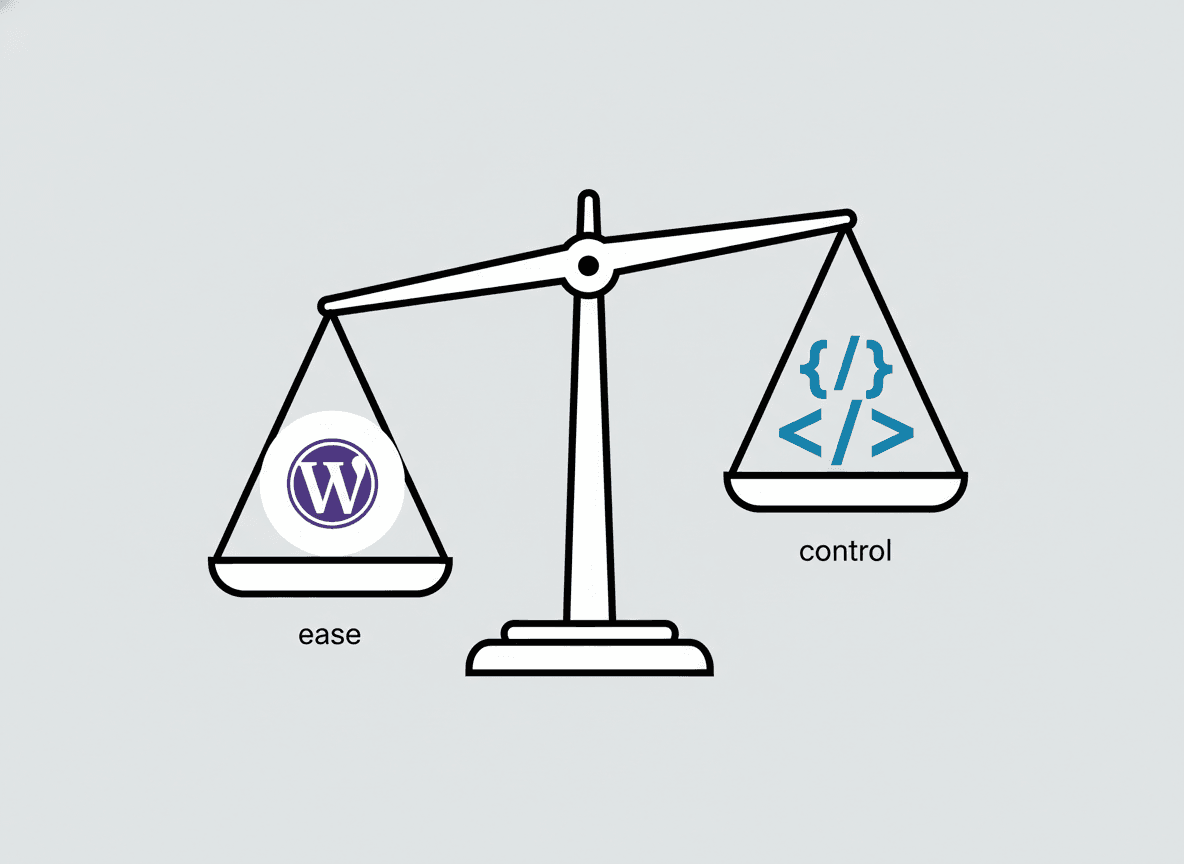
WordPress has its own costs—quality hosting, a maintenance plan, occasional plugin updates—but they’re predictable and modest. Understanding what website maintenance involves helps set realistic expectations before you commit to either path. The real cost of a cheap website on either platform is usually more than the sticker price suggests.
For most Phoenix-metro businesses, WordPress built by a skilled team hits the right balance: professional results, reasonable cost, and genuine ownership of your content. For complex applications with unique technical requirements, custom code may be the better path. The answer depends entirely on what you’re building and how you plan to use it.
Which platform should you choose?
Here’s a simple framework. Choose WordPress if you need to update your own content regularly, have a realistic budget for professional work but not an unlimited one, or plan to grow your site over time with new pages and blog posts. Choose custom code if you’re building a web application with complex logic, have an in-house developer on staff, or have specific performance requirements that a tuned WordPress build genuinely can’t meet.
Most Scottsdale service businesses, professional firms, and retailers land firmly in the WordPress category. The platform is the right tool for the job—when it’s built right. That’s the part worth spending your energy on.
If hosted website builders are also on your shortlist, our comparison of WordPress vs. Squarespace vs. Wix covers that side of the decision in detail.
If you’re still weighing your options, we’re happy to talk through your specific situation and give you an honest recommendation—reach out for a free quote.
Frequently asked questions
Is WordPress secure enough for a business website?
Yes, when properly maintained. WordPress core is actively maintained by a large security team. The vulnerabilities that make headlines almost always trace back to abandoned plugins or outdated themes—not the core platform. Keep everything updated, use strong credentials, and choose quality hosting, and WordPress is a thoroughly secure foundation for a business site.
Can a WordPress site match the speed of a custom-coded site?
In most real-world scenarios, yes. Optimized WordPress—lightweight theme, caching, CDN, compressed assets—regularly scores in the 90s on Google PageSpeed Insights. The performance gap between a well-optimized WordPress site and a lean custom site is usually invisible to actual visitors and rarely affects rankings.
Will I be able to update a WordPress site myself?
Yes. That’s one of WordPress’s biggest advantages for business owners. Adding a blog post, updating a team member’s photo, or changing your hours takes minutes in the block editor—no developer needed. We set up every WordPress build so the owner can handle routine content updates without technical help.
What are the ongoing costs of a WordPress website?
Plan for quality managed WordPress hosting ($30–$80/month), a maintenance plan to keep plugins and core updated ($50–$150/month depending on the scope), and periodic content or design updates as your business evolves. These costs are predictable and modest compared to the cost of rebuilding a neglected site every few years.
When does it actually make sense to go custom-coded?
Custom code makes sense when you’re building a web application with unique logic—a custom booking engine, a client portal with complex permissions, or a platform serving large numbers of concurrent users. For the vast majority of business websites, WordPress built by a skilled team delivers equivalent results at a fraction of the cost and with far easier long-term management.